Guide · · Scissor Lifts & Access Platforms
Cherry picker sizing: how much height and platform capacity to buy
A cherry picker, meaning a self propelled articulated boom lift, costs from £19,350 ex VAT and earns that money only when you have to reach up and over something. For straight vertical work, a twin mast access platform listed at 12 m carries 200 kg from £2,310 ex VAT and an 8 m platform carries 125 kg from £1,195 ex VAT. Size the machine on working height, which is about 2 m above the height the platform itself reaches, and on the kilograms you need standing on it.
What a cherry picker is, and what most buyers actually need
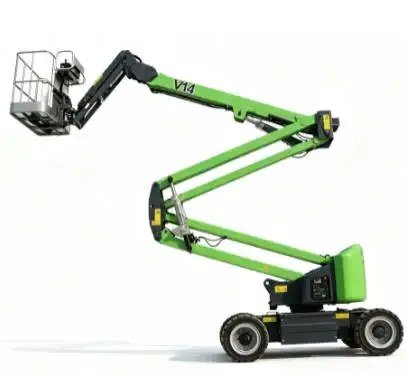
In UK trade use a cherry picker is a boom lift: a platform on the end of a jointed arm that can be raised, slewed and articulated so the basket reaches out sideways as well as up. It is also called a MEWP, a mobile elevating work platform, or an aerial work platform. That jointed arm is what you are paying for, and it is the reason a self propelled articulated boom lift is from £19,350 ex VAT while a vertical machine of similar platform capacity is a tenth of that.
Most enquiries that start with the words cherry picker turn out to be vertical jobs: lamps and light fittings, ducting, sprinkler heads, signage, camera and alarm work, stock at the top of racking, seasonal displays. If the platform only ever needs to travel straight up from a spot the machine can stand on, a mast platform or a scissor lift does the work for a great deal less money.
Buy the boom when there is something in the way: a conveyor line, a run of racking, a plant room full of pipework, a canopy over a shop front, a loading bay you cannot park a machine under. Reaching up and over is a boom job and nothing else does it.
Working height or platform height: which number to buy on
Two heights get quoted for every access platform and they are about 2 m apart. Platform height is how far the floor of the basket travels off the ground. Working height is the conventional figure for how high a person on that platform can work, taken as platform height plus roughly 2 m for an average person reaching up. A machine listed at 8 m in one place and 6 m in another is usually the same machine described two ways, so check which number you are reading before you compare two quotes.
Measure the job from the floor to the thing you need your hands on, then work back. A warehouse light fitting at 7.5 m needs about 5.5 m of platform height, which an 8 m electric lifting platform from £1,195 ex VAT covers comfortably. Racking at 11 m or high level plant needs a twin mast machine such as the 12 m vertical mast lift from £2,310 ex VAT.
Do not buy tight. A machine that just reaches means working at full extension with your arms above your head, which is slow and uncomfortable, and it leaves you with nothing when the next job is half a metre higher.
Platform capacity: one person, two people, or a person plus materials
Platform capacity is the total on the platform: people, workwear, tools, and whatever you are fitting. A single operator with a tool bag is commonly reckoned at around 100 kg, so a 125 kg platform is a one person machine with a modest kit and nothing more. Two people, or one person with a length of trunking and a box of fittings, wants 200 kg or better. Shopfitting and maintenance crews who work in pairs should start at 300 kg.
| Machine | Platform capacity | Height as listed | From price ex VAT |
|---|---|---|---|
| Electric lifting platform, single mast | 125 kg | 8 m | from £1,195 |
| Dual mast scissor type platform | 300 kg | 8 m | from £1,470 |
| Twin mast vertical lift | 200 kg | 12 m | from £2,310 |
| Self propelled articulated boom lift | 200 kg | Boom, reaches up and over | from £19,350 |
Note what the table shows about price and capacity: the dual mast platform at 300 kg is from £1,470 ex VAT, less than the taller 200 kg machine. Height costs more than kilograms on vertical machines, so if the job is at 6 m to 8 m and the crew works in pairs, the wider capacity is the cheaper decision.
Indoor floors and outdoor ground: where the machine can stand
Height sells the machine, but the floor decides whether it can be used. Indoors, ask two questions: what the wheel loading does to the floor finish, and whether the floor is level enough for the machine to lift. Vinyl, tiles, coated concrete and raised access floors all have limits, and a heavy machine on small wheels concentrates a lot of weight on a small patch. Non marking wheels are worth asking for on a finished floor.
Outdoors, the surface has to be firm and level. Mast platforms and most scissor type machines are built for solid, even ground and they will refuse to lift or will cut out beyond a small slope. Yard work on compacted hardcore, camber or tarmac in hot weather is where a machine on rough terrain wheels or a boom with outriggers is the right answer.
Power is the third question. Battery machines suit indoor work because there is nothing to breathe in, and a charging point near where the machine parks overnight saves daily aggravation. Battery type and charging detail are confirmed on your written quote.
Access, storage and the bits people forget
Before you commit, walk the route the machine has to take. Door widths, lift car dimensions, ramp gradients and the height of the machine when stowed all matter, especially in retail units and older buildings. A machine that cannot get to the job is worth nothing on site.
- Stowed height against your lowest doorway and any roller shutter.
- Turning space in the aisle or corridor where it will work.
- Where it parks and charges when it is not in use, ideally inside and out of the way.
- Who is trained to use it, and where that training is recorded.
- Who does the thorough examination, and when the next one falls due.
Powered access platforms used to lift people come under the Lifting Operations and Lifting Equipment Regulations 1998, which means a thorough examination at least every six months, and under PUWER 1998 for inspection and maintenance. Budget for that from the day the machine arrives rather than discovering it later.
What to check before you buy a cherry picker or access platform
Run through this list before you sign anything off. It is the difference between a machine that gets used every week and one that sits in a corner.
- The working height you actually need, measured from the floor to the work, not guessed from the ceiling height.
- Total platform capacity: people, tools and materials added up, then the next size up.
- Whether any part of the job is up and over an obstacle. If it is, only a boom will do it.
- Floor finish and wheel loading indoors, ground condition and slope outdoors.
- Battery type, charging arrangement and where the machine lives overnight.
- Guard rail height, gate type and how tools are secured on the platform.
- Operator training and the written record of it, plus the thorough examination schedule.
- What the quote covers: specification, price, freight, duty, VAT and lead time, all confirmed in writing.
If you can answer those eight, send them to us with the ceiling height and the floor type and we will come back with two or three machines from the access platform range that fit, with a price against each. If the answers point at a boom, we will say so, and if they do not, we will say that too.
Access platforms and boom lifts discussed in this guide
V11 New Self Propelled Electric Articulated Boom Liftfrom £19,350 ex VAT Vertical Mast Lift 12m Twin Mast Aluminium Alloy Lift 200 kgfrom £2,310 ex VAT
 Electric Aerial Work Platform AWP8-2000 Dual Mast Scissor Lift 300 kgfrom £1,470 ex VAT
 Electric Lifting Platform 8m Aerial Work Platform 125 kgfrom £1,195 ex VAT
Questions people ask
What is the difference between a cherry picker and a scissor lift?
A cherry picker is a boom lift: the platform sits on a jointed arm that can reach out sideways and over obstacles. A scissor lift raises its platform straight up on a folding frame and cannot reach out. Booms cost far more, from £19,350 ex VAT against from £1,470 ex VAT for a dual mast platform.
How do I work out the working height I need?
Measure from the floor to the point you need your hands on. Working height is taken as platform height plus about 2 m for a person reaching up, so subtract 2 m from your measurement to get the platform height the machine must deliver.
How much weight can an access platform carry?
It varies by machine. The ones in this guide run from 125 kg, a one person platform, up to 300 kg for two people with tools and materials. The rated capacity covers everything on the platform, not just the people.
Do operators need training to use an access platform?
Yes. Under PUWER 1998 an employer must make sure anyone using work equipment is adequately trained, and a powered access platform is a machine you would not put an untrained person on. Recognised operator training and a written record of it are the normal standard on UK sites.
Does an access platform need a thorough examination?
Yes. Equipment that lifts people falls under LOLER 1998 and needs a thorough examination by a competent person at least every six months, plus routine inspection and maintenance under PUWER 1998.
Can I buy a single machine rather than a batch?
Yes. Any quantity is welcome, from one machine upwards, and the written quote confirms the price for the quantity you ask for.
Sources: HSE: Lifting Operations and Lifting Equipment Regulations 1998 (LOLER), HSE: Provision and Use of Work Equipment Regulations 1998 (PUWER)