Guide · · Electric Pallet Stackers
Electric stacker truck lift height: which mast suits your racking
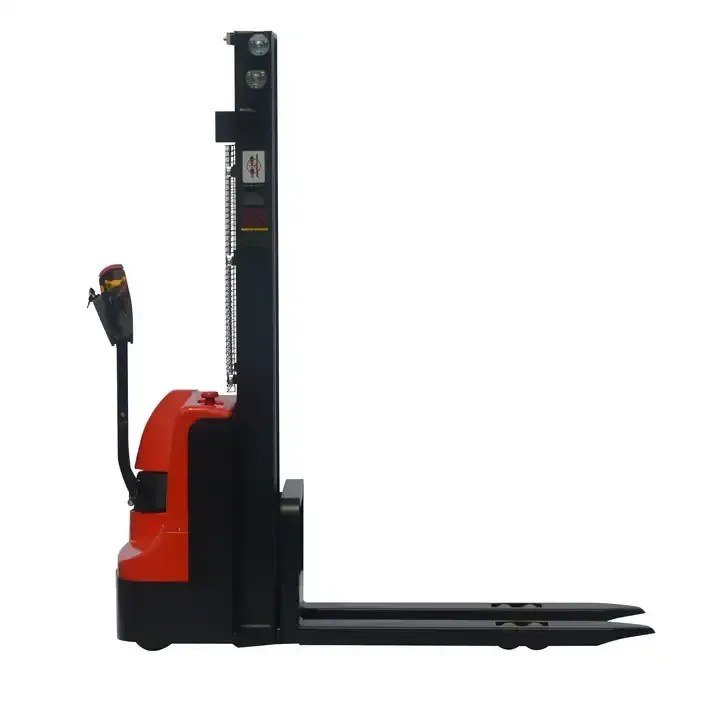
An electric stacker truck is normally specified at 1.6 m, 2 m, 3 m or 4 m of lift, and a reach or scissor type takes you to 5.5 m. Order the mast about 150 mm above your top beam landing height, then check the residual capacity at that height, because a truck plated at 1.5 t may carry less near the top of the mast. Guide prices run from £1,065 ex VAT for a 4 m two stage mast to £2,490 ex VAT for a triplex with 1,550 mm of free lift.
What lift height does an electric stacker truck need?
Start at the rack, not at the truck. Measure from the floor to the top of the beam you have to land a pallet on, then add roughly 150 mm so the forks lift clear of the beam and tilt is not needed to set the pallet down. If your top beam sits at 3,350 mm, a 3 m mast will not reach it and a 4 m mast will. That one measurement decides most of the specification.
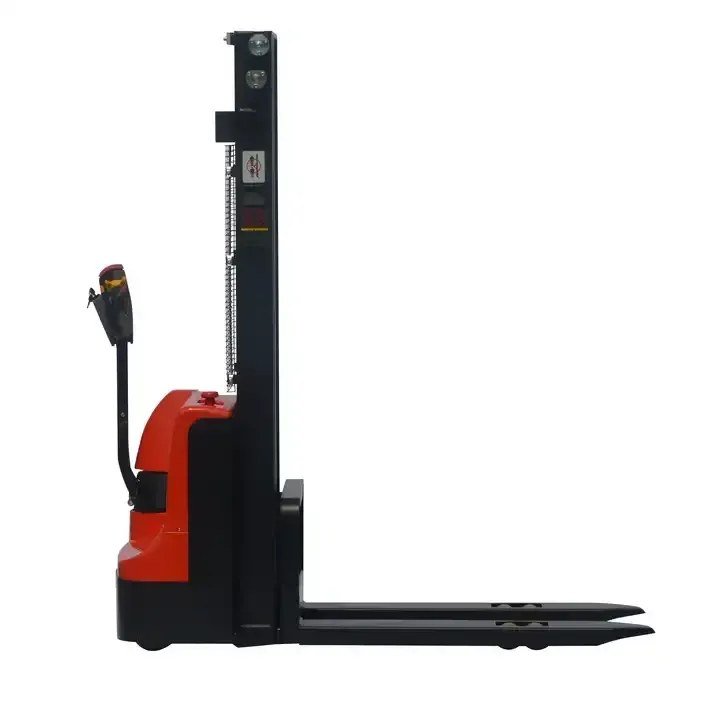
Across the electric stacker range the masts come in a familiar set of steps: 1.6 m, 2 m, 3 m and 4 m, with reach and scissor variants going to 5.5 m. A 1.6 m to 4 m walkie stacker on a lithium-ion battery starts from £1,065 ex VAT, and the same height band on a lead-acid truck with 1,150 to 1,220 mm forks is also from £1,065 ex VAT.
Two more heights matter and are easy to forget. The closed height of the mast has to pass under your lowest doorway, shutter or sprinkler run with the forks down. The extended height has to clear anything above the rack. Both are stated on the written quote, so send us the doorway height with the beam height and we will confirm the mast that fits.
Duplex, triplex or reach: which mast does what?
Mast stages are not about height alone. They change the closed height, the free lift and the price. Free lift is how far the forks rise before the mast itself starts to extend, which is what lets a truck work inside a lorry trailer or a shipping container.
| Mast type | Typical lift | Free lift | Suits | Guide price |
|---|---|---|---|---|
| Single stage | 1.6 m to 2 m | None to speak of | Stacking two pallets high, feeding a packing line, loading a tail lift | from £1,065 ex VAT |
| Duplex, two stage | 3 m to 4 m | Small | Most warehouse racking with normal roof and door heights | from £1,065 ex VAT |
| Triplex, three stage | 3 m to 4.5 m | Up to 1,550 mm | Low doorways, container and trailer work, mezzanine floors | from £2,490 ex VAT |
| Reach or scissor type | 3 m to 5.5 m | Varies by build | Top beams above 4 m, double deep or tall narrow aisle racking | from £1,885 ex VAT |
A 1,500 kg triplex mast stacker with 1,550 mm of free lift is from £2,490 ex VAT, and that premium over a two stage mast buys you one thing: height at the top without height at the bottom. If you never go inside a container and your doors are 3 m, a duplex does the same job for less money.
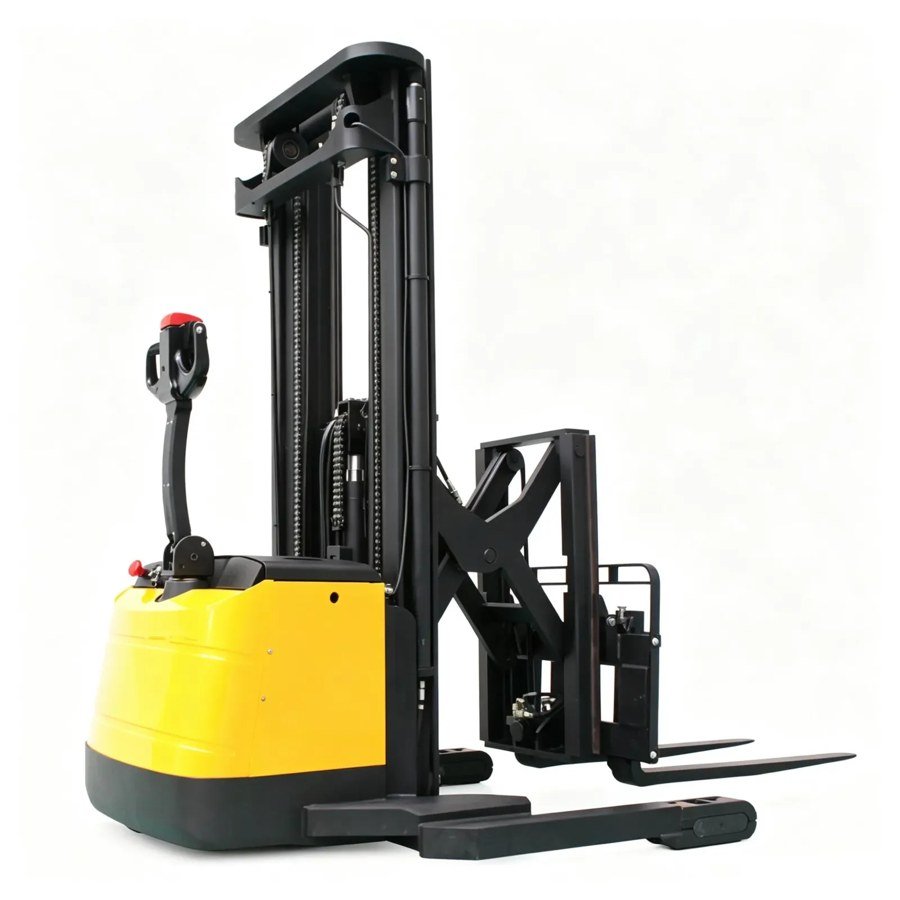
For the tallest work, a single scissor reach stacker rated at 1,400 kg covers 3 m to 5.5 m from £1,885 ex VAT. Above roughly 4.5 m, floor flatness and operator sightlines start to govern the choice as much as the mast does, and a forklift may be the better answer.
Residual capacity: why 1.5 t on the plate is not 1.5 t at 4 m
Every truck carries a capacity plate, and the headline figure applies at a stated lift height and load centre. As the mast extends, the rated capacity comes down. This is residual capacity, and it is the number your heaviest pallet has to fit under.
Work it through with a real pallet. If your heaviest line is 900 kg on a 1,200 by 1,000 mm pallet landing at 3,600 mm, you do not want a truck whose capacity at 4 m is 800 kg, even if the plate says 1.5 t. Load centre matters too: the plated figure assumes the load sits close to the fork heels, and a deep or badly built pallet pushes the centre of gravity forward and cuts the capacity again.
Tell us the heaviest pallet weight, the pallet footprint and the landing height together, and the residual capacity at that height is confirmed on your written quote before you order. It is the single most common reason a stacker gets specified one size too small.
Lead-acid or lithium-ion for your shift pattern?
Battery choice follows the hours, not the height. A lead-acid truck wants a full charge, usually overnight, and repeated part charges shorten its life. On one shift with the charger on at the end of the day, lead-acid is the sensible, lower cost option, and a lead-acid stacker covering 1.6 m to 4 m is from £1,065 ex VAT.
Lithium-ion takes opportunity charging. Twenty minutes on the charger at a break puts useful energy back, so two shifts off one truck becomes realistic without a second battery or a battery change area. There is nothing to top up with water and no gassing, which matters if the charging point is near food or packaging stock. A lithium walkie stacker with 1.6 m to 4 m masts is from £1,065 ex VAT as well, so the decision is about how you charge rather than purchase price alone.
- One shift, charger free overnight: lead-acid.
- Two shifts, or a truck shared between departments: lithium-ion.
- Cold store or chilled areas: say so on the enquiry, because the battery and the hydraulic oil specification change.
- Charging near open food or packaging: lithium-ion avoids gassing and topping up.
What to check before you buy an electric stacker truck
Run through this list before you sign anything off. Each line is a question we will ask anyway when the quote is written.
- Top beam landing height, plus 150 mm of clearance, gives the mast height.
- Lowest doorway or shutter height with forks down gives the maximum closed height.
- Heaviest pallet weight and footprint, checked against residual capacity at your landing height.
- Aisle width at the narrowest point, measured with pallets overhanging the beams, not from the rack drawing.
- Pallet type: open bottom boards and closed base pallets suit fork over legs, while a perimeter base or a stillage needs a straddle or a counterbalance front end. Compare the options on the electric stacker and manual and semi electric stacker pages.
- Floor condition, gradient and whether the truck crosses a yard or a dock plate.
- Fork length against your pallet depth, commonly 1,150 mm forks for a 1,200 mm deep pallet.
- Operator training under PUWER 1998, and a thorough examination regime if the truck is ever used to lift a person or an attachment that lifts.
Prices on the site are guide prices in GBP ex VAT. Price, freight, VAT and lead time are confirmed on your written quote, which stays valid for 30 days. More background on specifying trucks is in the buying guides.
Electric stacker trucks by mast height
Questions people ask
How high can an electric stacker truck lift?
Common mast heights are 1.6 m, 2 m, 3 m and 4 m, and reach or scissor types reach 5.5 m. Above about 4.5 m the floor and the operator sightline matter as much as the mast, so a forklift is often the better choice.
What is free lift and do I need it?
Free lift is how far the forks rise before the mast extends upward. You need it if the truck works inside a container, a trailer or under a low doorway, and a triplex mast offers up to 1,550 mm of it from £2,490 ex VAT.
Will a 1.5 t stacker lift 1.5 t at the top of the mast?
Usually not. Rated capacity falls as the mast extends, so check the residual capacity at your landing height against your heaviest pallet. That figure is confirmed on your written quote.
Do I need a licence to operate an electric stacker truck?
There is no driving licence requirement, but PUWER 1998 requires that operators are trained and competent on the specific truck. Keep the training records with the truck.
Should I choose lead-acid or lithium-ion?
Lead-acid suits a single shift with an overnight charge and costs less to buy. Lithium-ion takes short charges at breaks, so it suits two shifts or a truck shared between departments.
How much does an electric stacker truck cost?
Guide prices start from £1,065 ex VAT for a walkie stacker with masts from 1.6 m to 4 m. A reach type covering 3 m to 5.5 m is from £1,885 ex VAT, and a triplex mast with 1,550 mm free lift is from £2,490 ex VAT.
Sources: HSE: PUWER 1998 guidance, HSE L117: Rider operated lift trucks, operator training