Comparison · · Manual & Semi-Electric Pallet Stackers
Manual pallet stacker or semi-electric? Where the extra money earns its keep
A manual pallet stacker is pushed by hand and lifted by pump, reaches about 1.6 m as standard and starts from £168 ex VAT for a 0.5 t model with 1000 mm forks. A semi-electric stacker keeps the hand push but raises the mast on a battery, from £700 ex VAT, and earns that gap once one operator is lifting pallets all day rather than a few times a week. Above 2 t, or above about 3 m, move up to a full electric stacker.
What is a manual pallet stacker and what does it actually do?
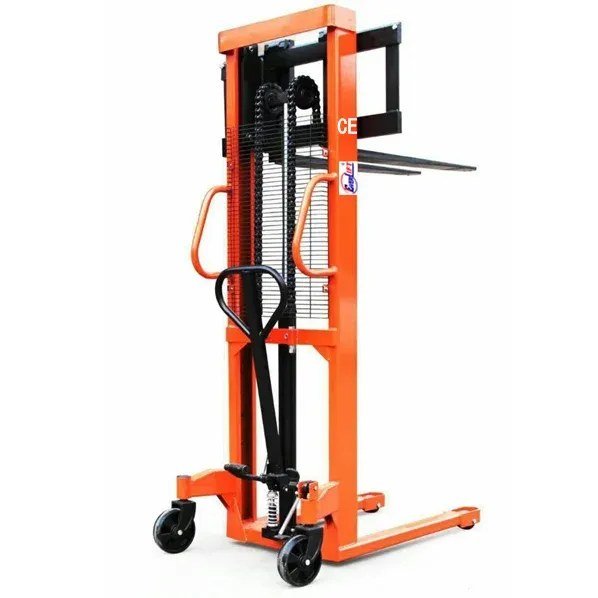
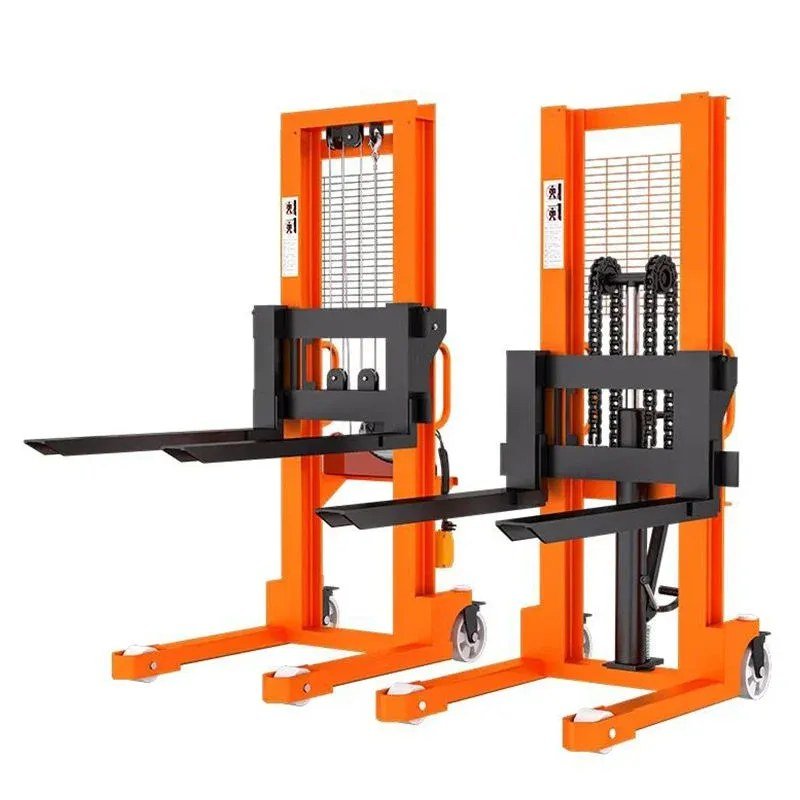
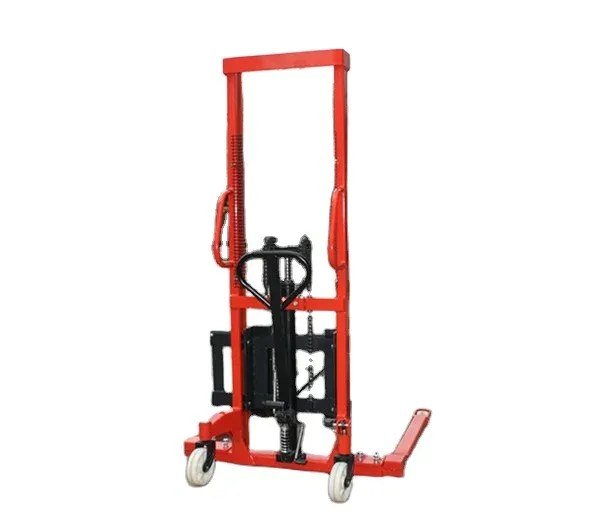
A manual pallet stacker, also called a hand stacker or a manual forklift, is a walk behind mast truck. You push it by hand, slide the forks into a pallet the way a pump truck does, then raise the mast with a foot pedal or a hand lever. There is no traction motor, no battery and no charger, which is why a 0.5 t unit with 1000 mm forks starts from £168 ex VAT.
The lift is the whole point. A pump truck moves a pallet along the floor. A stacker puts it somewhere: a second racking beam, a mezzanine edge, a stillage, a work bench or the bed of a van. If your team is currently breaking pallets down by hand because nothing in the building will lift a loaded one, a stacker is the machine that stops the double handling, and it does it for the price of a good pump truck and a bit more.
The trade off is effort. Every lift is 30 to 40 pump strokes on the pedal, and the operator supplies all of it. That is fine for a handful of lifts a day and tiring by the twentieth.
Manual, semi-electric or full electric: what the extra money buys
The ranges overlap, so compare them on the three things that change: who does the lifting, who does the pushing, and what the truck costs to keep running.
| Type | Lift | Travel | Typical capacity | Guide price |
|---|---|---|---|---|
| Manual stacker | Hand or foot pump | Operator pushes | 0.5 t to 2 t | from £168 ex VAT |
| Manual stacker, longer forks | Hand or foot pump | Operator pushes | 1 t to 2 t | from £235 ex VAT |
| Manual stacker, tall mast options | Hand or foot pump | Operator pushes | 1.5 t | from £335 ex VAT |
| Semi-electric stacker | Battery and motor | Operator pushes | 1 t to 2 t | from £700 ex VAT |
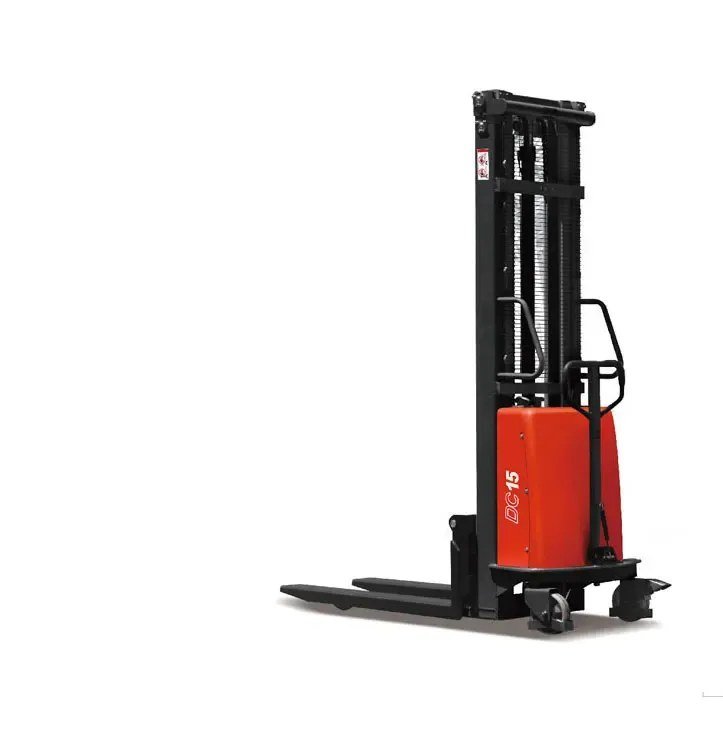
A semi-electric stacker is the middle step and the one most buyers underrate. The operator still walks the load to where it is going, so you keep the small footprint and the low price of a walk behind truck, but the mast goes up on a button. On a 1 to 2 t semi-electric stacker from £700 ex VAT you also gain repeatable lift height, which matters when the pallet has to land cleanly on a beam rather than be nudged up in stages.
Go to a full electric stacker when the truck also has to drive itself, when the load is over 2 t, or when the distance between pick and drop is more than a few metres.
How high and how heavy can a manual pallet stacker realistically go?
On paper the catalogue reads 1.6 m, 2 m, 2.5 m and 3 m, and a 1.5 t hand stacker with those four mast options starts from £335 ex VAT. In practice the taller the mast, the more the rated capacity tapers off near the top, and the more pump strokes each lift costs. Ask for the load chart on your quote rather than assuming the headline capacity holds at full height.
Two numbers decide most of it:
- Lift height. Measure from the floor to the top surface of the beam you are landing on, then add roughly 100 mm so the pallet clears. A second beam at 1.4 m is comfortable on a 1.6 m mast. A beam at 2.4 m needs the 2.5 m or 3 m option.
- Capacity at height. A 2 t rating is usually a ground level figure. If your heaviest pallet is 1.2 t and it is going to 2.5 m, say both numbers when you ask for the quote.
Anything heavier than 2 t, or anything going above about 3 m, is forklift or full electric stacker territory. Pushing a manual truck past its comfortable range is where floors get scuffed and operators get hurt.
Straddle legs or standard legs: which fits your pallets?
This is the detail that catches people out after the truck arrives. Standard legs run under the pallet, so the truck suits open bottom pallets and closed boards where nothing blocks the leg path. Straddle legs run outside the pallet, so the truck can pick up closed bottom pallets, stillages, box pallets and anything sitting on the floor with no clear gap underneath.
Fork length follows the same logic. A 1000 mm fork suits a standard 1200 by 1000 mm pallet entered from the 1000 mm side. If you handle euro pallets from the long side, or anything deeper, the 1 to 2 t stacker with 1150 to 1220 mm forks from £235 ex VAT is the safer choice. Overhanging a pallet by 200 mm is not a small problem on a mast truck.
Measure a real pallet from your own stock before you order, not a drawing. Fork width, fork length and leg spread are all specified on the written quote.
How many lifts a shift before you should pay for a battery?
There is no rule in a regulation on this, so use the operator as the measure. Count the lifts in a normal day. Up to around ten or fifteen, a manual stacker is comfortable and the money saved is real. Somewhere past twenty lifts a day the pumping starts to show up as slower work in the afternoon, and past thirty it becomes the reason the job takes as long as it does.
Put the £700 ex VAT semi-electric price against what you already spend. One truck serving two people, all day, for several years is a different calculation from a truck that lifts a delivery onto the mezzanine twice a week. The second case is exactly what a manual stacker is for.
Battery type matters at the top of the range: lead-acid units are cheaper to buy and heavier, lithium-ion units charge in shorter bursts and suit multi shift sites. Both are quoted with the charger, and the specification is confirmed on your written quote.
What to check before you buy a manual pallet stacker
- Floor condition. Small hard wheels need a flat, sound floor. Broken concrete, expansion joints and ramps all fight a hand pushed mast truck.
- Headroom. Check the closed mast height against your lowest doorway, shutter and van roof, not just the racking. A 3 m mast is tall when lowered.
- Pallet type. Open bottom or closed bottom decides standard legs or straddle legs. Confirm it before the order goes in.
- Load chart. Get the rated capacity at the working height you need, not the headline number.
- Inspection duties. A stacker is lifting equipment, so the thorough examination and pre-use check duties under LOLER 1998 and PUWER 1998 apply. Budget the inspection into the running cost.
- Operator brief. No licence is required for a pedestrian stacker, but PUWER still requires the operator to be trained and competent on that truck.
- Order quantity. Everything is made to order at our partner factories, so check the minimum order for the model you want. Price, freight, duty, VAT and lead time are all confirmed on your written quote.
If you are unsure between two mast heights, send the beam height and the heaviest pallet weight with your enquiry through the stacker range and we will quote the load chart against your numbers.
Manual and semi-electric stackers in this guide
Questions people ask
How much is a manual pallet stacker?
A 0.5 t hand stacker with 1000 mm forks starts from £168 ex VAT. A 1 to 2 t model with 1150 to 1220 mm forks starts from £235 ex VAT, and a 1.5 t version offered with 1.6 m to 3 m masts starts from £335 ex VAT.
What is the difference between a manual and a semi-electric stacker?
Both are pushed by the operator. A manual stacker raises the mast on a hand or foot pump, while a semi-electric stacker raises it on a battery powered motor. Semi-electric units start from £700 ex VAT.
How high does a manual pallet stacker lift?
Common mast options are 1.6 m, 2 m, 2.5 m and 3 m. Rated capacity usually reduces towards the top of a tall mast, so ask for the load chart at the height you actually need.
Do you need a licence to use a pallet stacker?
No licence is required for a pedestrian stacker in the UK, but PUWER 1998 requires the operator to be trained and competent on the specific truck, and the machine is subject to LOLER inspection duties.
Can a manual stacker lift a closed bottom pallet?
Only if it has straddle legs that run outside the pallet. Standard legs run underneath, so they need an open bottom pallet or a clear gap below the load.
Is a stacker or a pump truck right for my warehouse?
A pump truck moves pallets along the floor. Choose a stacker when a pallet has to go onto a beam, a mezzanine, a stillage or a van bed. Many sites run both, one of each.
Sources: HSE: Lifting Operations and Lifting Equipment Regulations 1998 (LOLER), HSE: Provision and Use of Work Equipment Regulations 1998 (PUWER)