Comparison · · Electric Pallet Stackers
Walkie pallet stacker or stand-on: which one suits your run?
A walkie pallet stacker is driven from a tiller by an operator on foot and starts from £1,035 ex VAT; a stand-on version of the same truck puts the operator on a fold down platform and starts from £1,315 ex VAT. Pick the walkie when the run from the bay to the racking is short and the aisle is tight. Pick the stand-on when the operator covers the length of the building all day, because walking pace is what limits pallets per hour.
What is a walkie pallet stacker, and what makes a stand-on different?
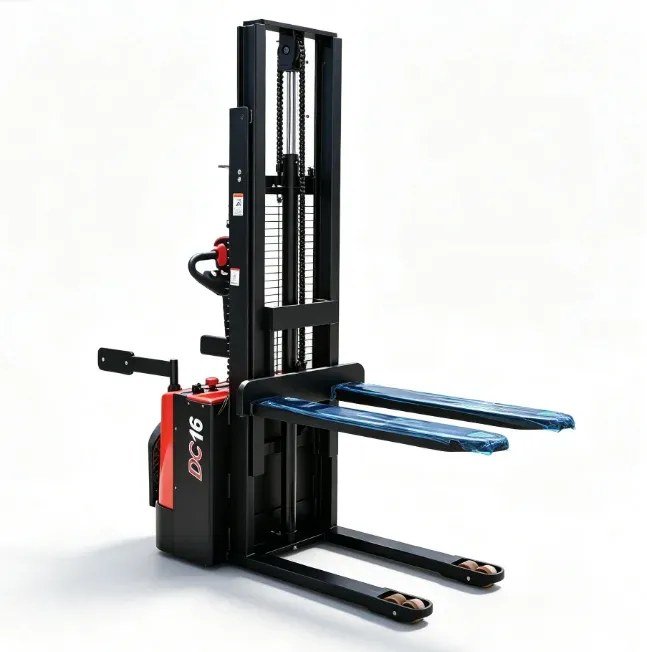
A walkie pallet stacker, also called a walk behind stacker truck or a pedestrian stacker, is steered from a tiller arm by an operator walking alongside it. The motor drives the wheels and raises the mast, so nothing is pumped by hand, but the operator still covers the ground on foot. A stand-on version of the same machine adds a fold down platform and a back rest or protective arm, so the operator rides instead of walks.
Under the covers the two are close relatives. Across our electric stacker range capacities run from 800 kg to 2 t, forks from 1,000 mm to 1,220 mm and masts from about 1.6 m to 4.5 m in either style. What changes is travel speed, how long an operator can keep the pace up, and how the truck behaves at the end of an aisle. That is why the choice is worth ten minutes with a tape measure and a shift plan rather than a glance at a price list.
Walkie pallet stacker or stand-on: which one for your aisles?
Set the two side by side on the points a buyer actually has to decide. Guide prices below are the from-prices of trucks we list today, ex VAT.
| Point to compare | Walkie pallet stacker | Stand-on stacker |
|---|---|---|
| Operator position | On foot, at the tiller | On a fold down platform behind a back rest or protective arm |
| Travel speed | Walking pace | Quicker than walking pace, so more pallets per hour over distance |
| Suits | Goods in to the first aisle, a single aisle, tail lift to the bay | A bay at one end of the building and racking at the other |
| Capacity we list | 1.2 to 1.5 t | 1.5 to 2 t |
| Narrowest chassis we list | Fork over and straddle legs sized to the pallet | 780 mm across on the brushless stand-on |
| Charging | Built-in charger available | Lead-acid or lithium-ion, charger specified on the quote |
| Guide price from | from £1,035 ex VAT | from £1,315 ex VAT |
The pattern is simple. A walkie wins on price and on tight spaces where the operator needs to step around the load. A stand-on wins when the operator would otherwise spend the shift walking.
How far does the operator walk in a shift?
This is the number that settles most of these conversations, and it costs nothing to work out. Pace the route once, from where pallets land to where they are put away, and count the pallets a shift moves.
Say the round trip is 60 m and the truck handles 30 pallets. That is 1.8 km on foot before any picking, double handling or trips back for a second pallet. At 120 m round trip it is 3.6 km. Somewhere in that range the walking, not the truck, becomes the limit on throughput, and a platform earns its keep.
Short runs point the other way. If the pallet comes off the tail lift and goes into the first bay of racking 10 m away, a stand-on platform mostly gets folded up and ignored, and the money is better spent on mast height or a second walk behind truck.
What does the step up to a stand-on stacker cost?
Less than most buyers expect. The ladder across trucks we list today runs like this, all ex VAT and all guide prices that a written quote confirms:
- Full electric walk behind stacker, 1.2 to 1.5 t, lithium-ion: from £1,035 ex VAT.
- Walkie fork over stacker with a built-in charger, 1.2 t: from £1,065 ex VAT.
- Stand-on stacker with a protective arm, 1.5 to 2 t: from £1,315 ex VAT.
- Brushless stand-on stacker, 1.5 t, 780 mm chassis: from £1,910 ex VAT.
So the platform itself is a modest step at 1.5 t. The larger jumps come from what else is on the truck: a brushless motor, a narrow chassis, a taller mast or lithium-ion in place of lead-acid. Our price guide explains how these guide figures are set, and freight, duty, VAT and lead time are confirmed on your written quote.
Does a stand-on stacker need more floor space?
Not always, and this is where buyers often guess wrong. The platform folds flat against the chassis, so the truck parks in roughly the footprint of the walk behind version. Where it does cost you is the turn at the end of an aisle: with the operator aboard, the machine needs a wider sweep than a walking operator who can simply step aside and pull the tiller round.
The answer is to measure the narrowest point of the route, not the widest aisle. Doorways, the gap between a stillage and a racking leg and the turn out of the loading bay are what catch people out. Where space is genuinely tight, the 780 mm brushless stand-on is the one to look at, and if the job is only moving pallets at floor level rather than stacking them, an electric pallet truck does it in less room again.
What to check before you buy a walkie pallet stacker
- The floor. Both types want a level, sound indoor floor. Broken concrete, steep ramps and yard surfaces are a different specification.
- The narrowest point. Measure doorways and the turn out of the bay, not the open aisle.
- Mast height against your top beam. Order roughly 150 mm above the landing height, then check the residual capacity at that height: a truck plated at 1.5 t may carry less near the top of the mast.
- Closed base pallets and stillages. If you lift those, you need straddle legs rather than a fork over chassis.
- Charging. Decide where the truck charges before it arrives. A built-in charger plugs into a mains socket; a separate charger needs its own space and a ventilated spot for lead-acid.
- Training. PUWER 1998 requires the employer to make sure whoever uses the truck is trained and authorised, whatever the machine cost.
- Thorough examination. Lifting equipment falls under LOLER 1998, so plan the inspection regime alongside the purchase.
Send us the pallet weight, the lift height, the narrowest point on the route and the hours the truck will run, and we will come back with the specification and a written quote that confirms price, freight, duty, VAT and lead time.
Walkie and stand-on stackers from our range
 Walkie Full Electric Stacker Forklift 1200 to 1500 kgfrom £1,035 ex VAT
 Walkie Fork Over Electric Stacker with Built-in Charger, 1.2 tfrom £1,065 ex VATStand-on Electric Pallet Stacker with Protective Arm, 1.5 to 2 tfrom £1,315 ex VAT
 1500 kg BLDC Brushless Stand-on Electric Stacker 780mm (LPT-02672)from £1,910 ex VAT
Questions people ask
Do you need a licence to drive a walkie pallet stacker?
There is no driving licence requirement for a pedestrian stacker in the UK. PUWER 1998 puts the duty on the employer to make sure the operator is trained, competent and authorised to use it, and the same applies to a stand-on truck.
How much does a walkie pallet stacker cost?
A full electric walk behind stacker starts from £1,035 ex VAT in our range, and a stand-on with a protective arm from £1,315 ex VAT. The figure for your capacity, mast and battery is confirmed on your written quote.
Can a walk behind stacker lift to 3 m?
Yes. Masts in this range are commonly specified between about 1.6 m and 4.5 m. Check the residual capacity at your working height, because the plated capacity applies lower down the mast.
Is a stand-on stacker too wide for a narrow aisle?
Not necessarily. We list a brushless stand-on stacker with a 780 mm chassis from £1,910 ex VAT. The limit is usually the turn at the end of the aisle rather than the straight run.
Does an electric stacker need a separate charging station?
Not if it has a built-in charger, such as the 1.2 t walkie fork over model from £1,065 ex VAT, which plugs into a mains socket. Lead-acid batteries charged from a separate unit need a ventilated spot set aside for them.
Which is better for a cash and carry?
It depends on the distance between the delivery bay and the racking. Short runs and tight back of house space suit a walkie pallet stacker; a long run across the building each time suits a stand-on.