Comparison · · Range
Pallet stacker or forklift? When a stacker truck is all your warehouse needs
A pallet stacker is enough when your heaviest pallet is 2 t or under, your top beam is no higher than about 4.5 m and the truck works indoors on a level floor. A full electric walkie stacker with a 3 m mast starts from £1,035 ex VAT, needs no operator licence and turns in an aisle a counterbalance forklift cannot. Choose a forklift for heavier loads, taller racking, yard work or side loading a lorry.
What is a pallet stacker and how does it differ from a forklift?
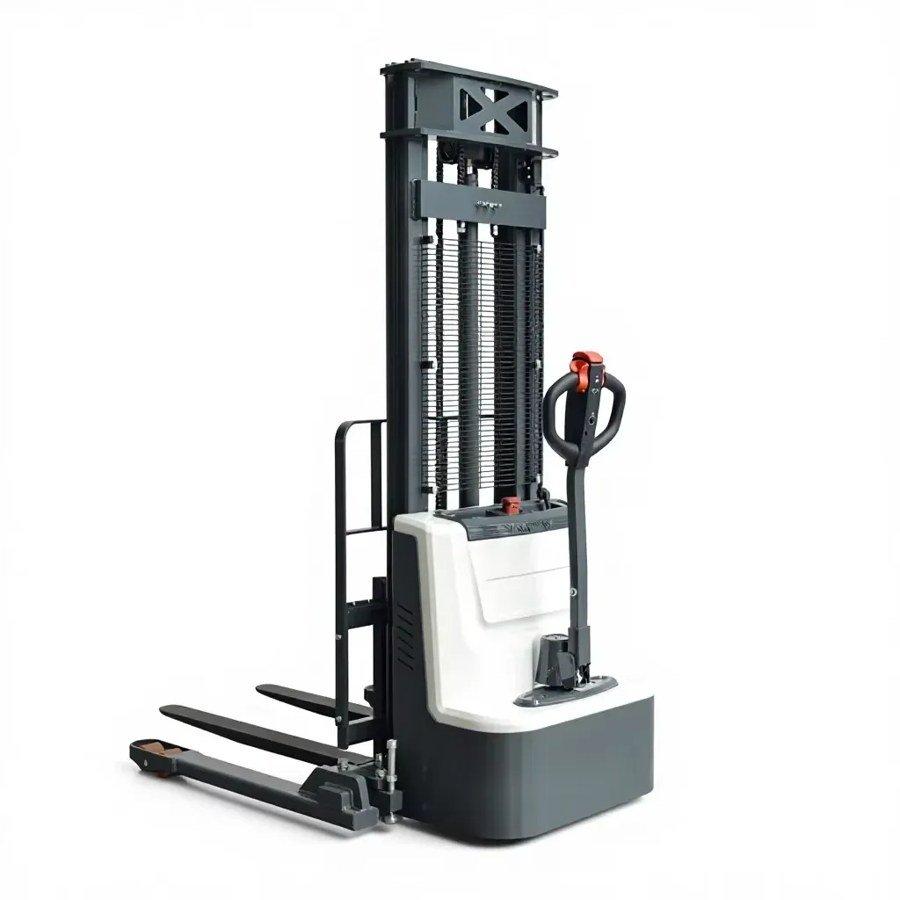
A pallet stacker, also called a stacker truck or electric stacker, is a pedestrian or stand-on truck with a mast that lifts a pallet from the floor into racking. It does the stacking part of a forklift's job with far less weight and floor space. The operator walks behind a tiller arm or stands on a platform, and on walkie and straddle models the load sits over the truck's own front legs, so there is no counterweight.
A counterbalance forklift carries the load out in front of its wheels and balances it with a heavy rear weight. That lets it lift heavier pallets higher, run outside and load a lorry from the side. It is also why it costs more, weighs more and needs a wider aisle to turn. The models in this guide, from our electric stacker range, run from 0.8 t to 1.5 t and from 1.6 m to 3.5 m lift, with triplex mast models reaching 2 t and 4.5 m.
When is a pallet stacker enough?
A stacker is enough when all of the following are true. Your heaviest pallet is 2 t or under and most are 1.5 t or under. Your top beam is no higher than about 4.5 m, and 3 m to 3.5 m is the common case. The floor is level concrete, indoors or under cover. The truck works in bursts, feeding racking, a packing bench or a pick face, rather than driving all shift. Goods arrive on a dock or a tail lift, so the stacker never lifts onto a lorry bed from ground level.
That describes most cash and carry back rooms, supermarket stock rooms, 3PL pick modules and small factories. The full electric walkie stacker, 1 to 1.5 t with a 3 m mast, from £1,035 ex VAT, is the model most of those buyers settle on. If two or more of the conditions fail, read the forklift section before you order.
Walkie, straddle, stand-on or counterbalance: which stacker type?
The four types differ in how they carry the load, which pallets they accept and how fast they travel. Guide prices are ex VAT; your written quote confirms price, freight, duty, VAT and minimum order.
| Type | How it works | Pallets | Capacity and lift | Guide price |
|---|---|---|---|---|
| Walkie (fork-over) | Pedestrian, forks sit over the support legs | Open-bottom pallets only | 1 to 1.5 t, 3 m mast, forks 1,000 to 1,200 mm | from £1,035 ex VAT |
| Straddle | Pedestrian, legs pass either side of the pallet | Any pallet, including closed-bottom | 1.5 t, 3 m to 3.5 m, forks 1,150 mm | from £1,060 ex VAT |
| Stand-on | Operator rides on a platform, faster over longer runs | As walkie or straddle, depending on the legs | 1.5 t, 780 mm chassis width, forks 1,150 mm | from £1,750 ex VAT |
| Counterbalance | No legs, rear counterweight, forks clear of the chassis | Any pallet, side loading and low racking | 0.8 t, 1.6 m lift, forks 1,070 mm | from £2,500 ex VAT |
The counterbalance stacker is the odd one out. It costs more per kilogram of capacity because the counterweight does the work of the legs, but it is the only stacker that can place a pallet on a lorry bed without straddling it. The 1,500 kg stand-on stacker is the choice when the racking is more than a short walk from the dock.
How much aisle width does a pallet stacker save?
Aisle width is usually the deciding factor, not price. A pedestrian stacker steers from the rear wheel with the load tucked over its legs, so for a 1,200 x 800 mm pallet the stacking aisle is typically around 2.3 m to 2.6 m. A counterbalance forklift of similar capacity typically needs 3.5 m or more, because the load hangs out in front and the whole truck has to swing to face the beam.
Over a long run of racking that is another row of pallets or a proper walkway. The exact figure is on each datasheet, so measure your narrowest aisle at floor level, including uprights and columns, and match it before you buy.
Do you need a forklift licence to drive a pallet stacker?
No, and not for a forklift either, because no forklift licence exists in UK law. What the law requires is training. PUWER 1998 regulation 9 says anyone who uses work equipment must have received adequate training in how to use it and the risks involved, and that applies to a walkie stacker as much as to a 3 t counterbalance truck.
HSE L117, the Approved Code of Practice for rider-operated lift trucks, sets out three stages of training, basic, specific job and familiarisation, and the certificate that records them. It applies in full to stand-on stackers because the operator rides. Pedestrian stackers fall outside the code's scope, but most UK employers train to the same three stages and keep the record on file, as the simplest way to show PUWER has been met.
LOLER 1998 adds a thorough examination at least every 12 months, because a stacker is lifting equipment, plus pre-use checks by the operator.
When should you buy a forklift instead?
Buy a forklift when any of these apply: pallets over 2 t; beams above 4.5 m; yard work, ramps, gravel or wet floors; loading from the side of a lorry with no dock or tail lift; a truck that runs most of the shift, where a seated operator and a larger battery pay back; or attachments such as clamps, rotators or fork positioners.
Many sites run both: a forklift on the dock and one or two stackers in the racking aisles, where the forklift cannot turn. That usually costs less than widening the aisles to suit the forklift. Send us your racking plan and we will check it against the datasheets before you decide.
What to check before you buy a pallet stacker
- Pallet type and entry side. A fork-over walkie stacker needs open-bottom pallets: a Euro pallet entered from the 800 mm side works, a perimeter-base pallet does not. Closed-bottom pallets need the straddle stacker or a counterbalance model.
- Lift height. Measure to the top of your highest beam and add clearance to lift the pallet over it. Check the lowered mast height against your lowest door.
- Capacity at height. Rated capacity is at the bottom of the mast and falls as the forks rise, so read the load chart for the height you actually stack at.
- Aisle width. Match the datasheet stacking aisle to your narrowest aisle, measured at floor level.
- Floor and gradients. Level concrete indoors. Any ramp must be within the gradient on the datasheet, laden and unladen.
- Battery. Lead-acid costs less to buy and suits one shift with overnight charging. Lithium-ion suits opportunity charging across two shifts.
- Forks. 1,150 mm forks suit Euro and UK pallets; 1,000 mm forks suit shorter pallets or tight bays.
- The paperwork. Price, freight, duty, VAT, minimum order and lead time are confirmed on your written quote, valid 30 days. Every truck is inspected before dispatch, with photos and video sent to you, under our warranty terms. Business customers can apply for a trade account.
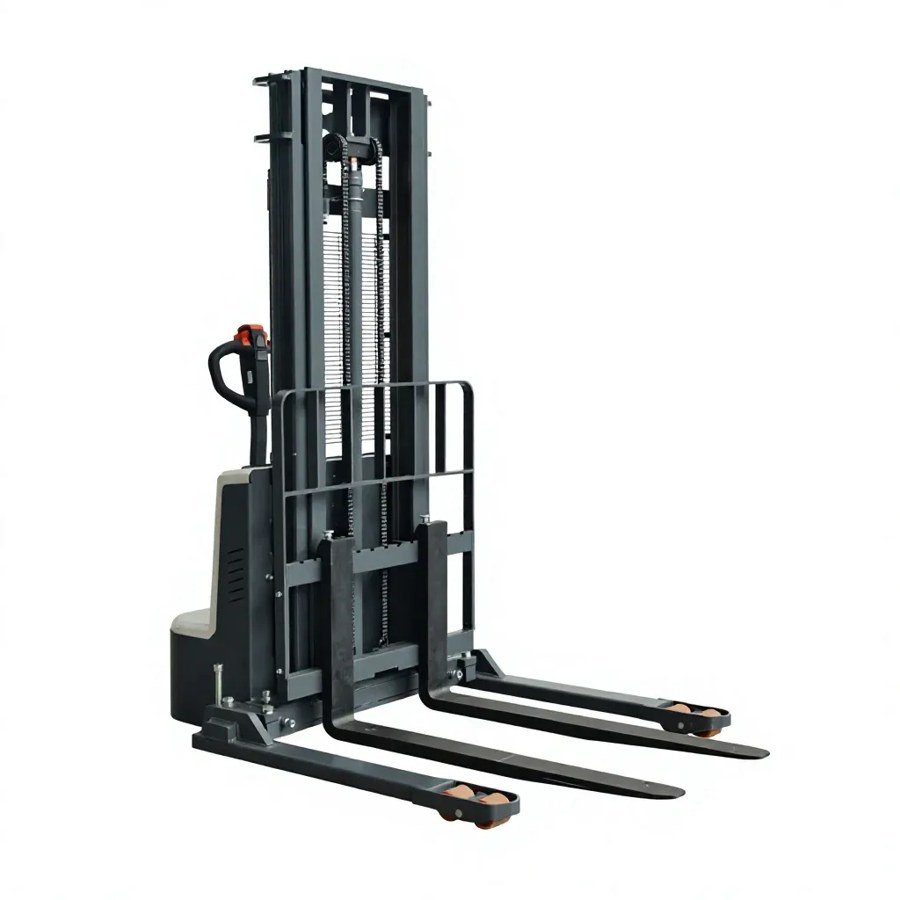
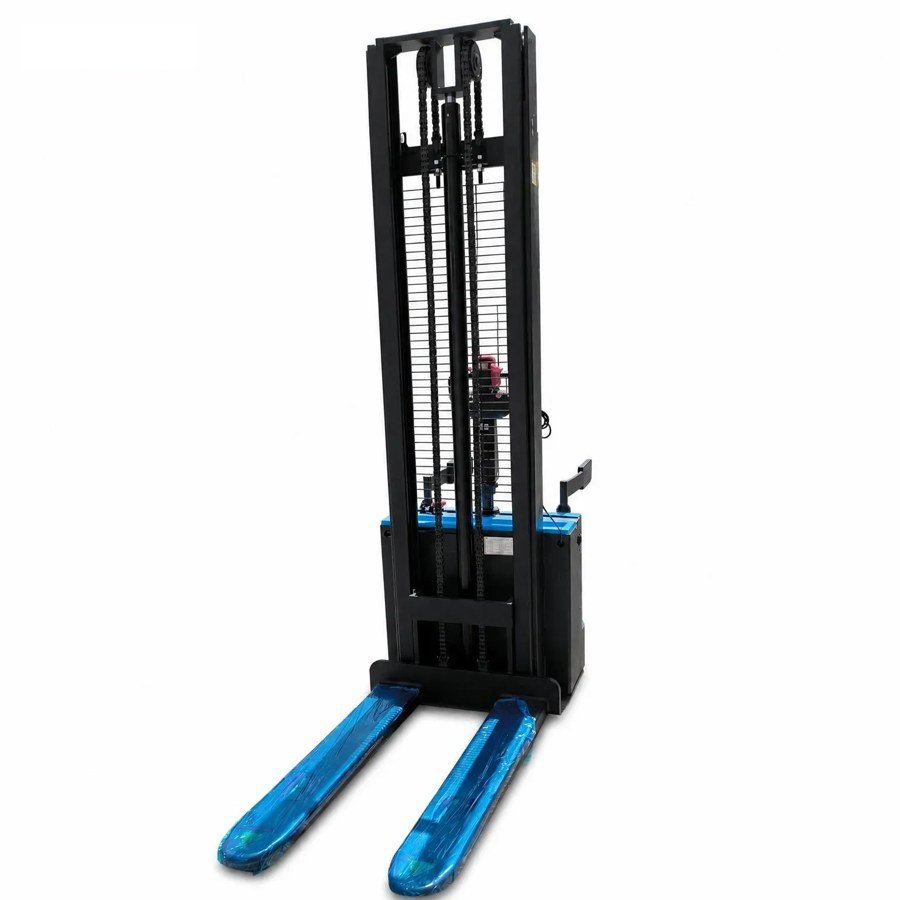
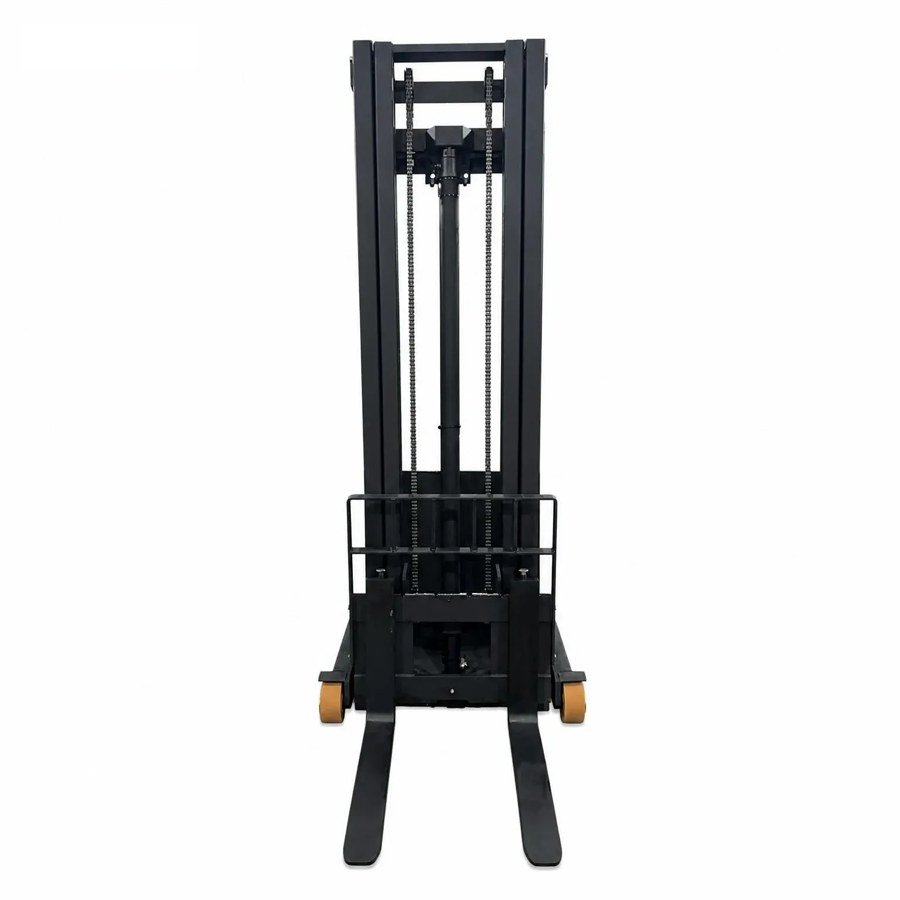
Stackers discussed in this guide
Questions people ask
Do I need a forklift licence to use a pallet stacker?
No. There is no forklift licence in UK law. PUWER 1998 requires you to train anyone who uses the stacker and keep a record; for stand-on models, follow the HSE L117 Approved Code of Practice for rider-operated trucks.
How high can a pallet stacker lift?
The models in this guide lift from 1.6 m on a compact counterbalance stacker to 3.5 m on a straddle stacker; triplex mast stackers in the range reach 4.5 m. Above that, a forklift or reach truck is the usual answer.
What is the difference between a walkie stacker and a straddle stacker?
A walkie or fork-over stacker carries its forks directly over the support legs, so it only takes open-bottom pallets. A straddle stacker has wider legs that pass either side of the pallet, so it takes closed-bottom pallets too.
Can a pallet stacker load a lorry?
Only a counterbalance stacker can, because it has no legs to foul the lorry bed, and only if the bed height is within its lift height. Walkie, straddle and stand-on stackers need a loading dock or a tail lift.
Is a semi electric stacker enough for a small stock room?
A semi electric stacker has powered lift but is pushed by hand, so it suits light pallets, short distances and occasional use. For daily stacking of 1 t pallets a full electric walkie stacker, from £1,035 ex VAT, is the better buy.
How often does a pallet stacker need a LOLER inspection?
A stacker is lifting equipment under LOLER 1998, so it needs a thorough examination by a competent person at least every 12 months, plus the operator's pre-use checks.
Sources: HSE L117 Rider-operated lift trucks: operator training and safe use, HSE PUWER 1998 guidance, HSE LOLER 1998 guidance